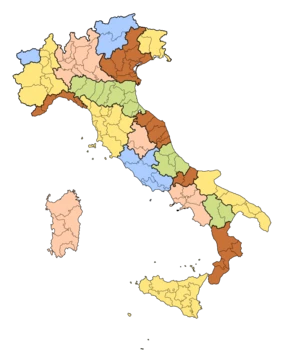
Abruzzo
A southern Italian region known for its extensive protected natural areas.

Abruzzo, historically also known as Abruzzi, is a region of southern Italy with a population of nearly 1.3 million. It is divided into four provinces: L'Aquila, Teramo, Pescara, and Chieti. Known as 'the greenest region in Europe,' half of its territory is protected through national parks and nature reserves, more than any other region in Italy. Its motto, 'forte e gentile' ('strong and kind'), was coined by 19th-century diplomat Primo Levi.
- Capital
- L'Aquila
- Largest City
- Pescara
- Population
- Nearly 1.3 million
- Provinces
- L'Aquila, Teramo, Pescara, Chieti
- Motto
- Forte e gentile ('strong and kind')
- Notable Feature
- Three national parks, one regional park, and 38 protected nature reserves
Lore & Background
The name Abruzzo likely derives from Aprutium, a popular evolution of '(ad) Praetutium,' meaning 'land of the Praetutii,' an ancient Italic people. Alternatively, it may come from the Latin 'abruptus' ('steep' or 'precipitous'). Geographically, Abruzzo is divided into a mountainous western area containing the highest massifs of the Apennines (Gran Sasso d'Italia and Maiella) and a coastal eastern area with beaches on the Adriatic Sea. Culturally considered part of Southern Italy due to its historic association with the Kingdom of the Two Sicilies, it is geographically often considered part of Central Italy. The region is home to Calderone, one of Europe's southernmost glaciers. Abruzzo's parks and reserves host 75% of Europe's animal species, including the golden eagle, the Abruzzo chamois, the Apennine wolf, and the Marsican brown bear. Ancient Italic tribes such as the Pentri, Marsi, and Vestini fought against Rome in the Samnite Wars and later in the Social War, after which they obtained Roman citizenship.
Reader's Guide
Abruzzo's significance lies in its exceptional environmental protection, with half its territory designated as parks or reserves—the highest proportion of any Italian region. This has made it a refuge for rare species and a model for conservation in Europe. Historically, the region was a crossroads of ancient Italic peoples who resisted and later integrated into Roman civilization, contributing to the Social War's demand for political rights. Its medieval division into Abruzzo Citeriore and Ulteriore shaped its administrative identity. The motto 'forte e gentile' encapsulates a regional character noted by Primo Levi. Today, Abruzzo balances its mountainous interior, coastal tourism, and industrial centers like Avezzano, while its archaeological sites and protected landscapes attract visitors and researchers. The region's legacy includes preserving 75% of Europe's animal species within its borders and maintaining one of the continent's southernmost glaciers.
Did You Know?
- Abruzzo is known as 'the greenest region in Europe' because half of its territory is protected through national parks and nature reserves.
- The region's motto 'forte e gentile' was chosen by 19th-century Italian diplomat and journalist Primo Levi.
- Abruzzo's parks and reserves host 75% of Europe's animal species.
- The name Abruzzo may derive from the Latin 'abruptus,' meaning 'steep' or 'precipitous.'
A Landscape of Peaks and Protected Wilderness
Abruzzo stretches from the highest summits of the Apennines in its western interior to the Adriatic coastline in the east, creating a striking contrast of mountain and sea. The Gran Sasso d'Italia and the Maiella massif anchor the western highlands, while the eastern shore offers beaches along the Adriatic. What sets the region apart is its extraordinary commitment to conservation: half of its territory is locked away in three national parks, one regional park, and 38 protected nature reserves, earning it the title of Europe's greenest region. These protected zones safeguard habitats where the golden eagle, the Abruzzo chamois, the Apennine wolf, and the Marsican brown bear still roam, and together they shelter roughly three-quarters of all animal species found across the continent. Even Calderone, one of the southernmost glaciers in Europe, persists within the region's borders. The western boundary with Lazio sits just 80 kilometres east of Rome, making this wild landscape a startling counterpoint to the capital's urban sprawl.
Seven Hundred Thousand Years of Human Presence
Abruzzo's story as a human home stretches back roughly 700,000 years, making it one of the longest-occupied landscapes in Italy. Acheulean flint tools and weapons, gathered from river terraces at sites like Madonna del Freddo near Chieti and from the shores of vanished lakes at Caramanico Terme and Popoli, reveal successive waves of Homo erectus, Neanderthals, and modern humans. The most striking Neanderthal evidence comes from caves at Calascio, dating to the Middle Paleolithic. At Svolte di Popoli, archaeologists even uncovered hippopotamus bones alongside human artifacts, hinting at a warmer, wetter ancient environment. After a difficult Mesolithic interlude marked by climate shifts and scarce food, Neolithic farmers arriving from the Middle East brought agriculture to the region. A skeleton at Lama dei Peligni in the province of Chieti has been radiometrically dated to 6,540 BC. Villages of the Ripoli culture, flourishing in the fifth and sixth millennia BC, clustered on river terraces and hilltops, sometimes ringed by defensive moats, and used caves for ritual purposes while practising farming, herding, hunting, fishing, and painted pottery.
Italic Tribes and the Long Contest with Rome
Before Roman conquest, the territory now called Abruzzo was a patchwork of Italic tribes. Oscan-speaking groups such as the Pentri, Carricini, and Frentani lived alongside the broader Osco-Umbrian peoples: the Aequi, Praetutii, Vestini, Marrucini, Marsi, and Paeligni. Ancient writers regarded them as formidable warriors, and they clashed with Rome across the Samnite Wars of 343 to 290 BC. Some tribes accepted Roman alliance; others surrendered only after prolonged fighting. Once progressively Romanized, many of these communities turned to supporting Roman military campaigns, contributing to victories throughout the third and second centuries BC. Yet the relationship was never one-directional. During the Social War of 91 to 87 BC, the tribes rose again, this time demanding political rights. They established a short-lived confederation called Italia, with Corfinio as its capital. After the conflict ended, they secured Roman citizenship, and in the Imperial era the region's economy shifted toward trade and pastoralism. Augustus's administrative division placed the territory within Regio V Picenum and Regio IV Sabina et Samnium.
Naming, Identity, and the Motto Forte e Gentile
The very name Abruzzo carries layers of meaning. The most widely accepted explanation, first articulated by Renaissance historian Flavio Biondo in his Italia Illustrata, traces it to Aprutium, a popular evolution of ad Praetutium, meaning the land of the Praetutii, the ancient Italic people who dwelt around present-day Teramo. An alternative theory links the name to the Latin word abruptus, evoking steep, precipitous terrain. In 1273, King Charles I of Anjou's Treaty of Alife split the Justiciarate along the Pescara River into Abruzzo Citeriore and Abruzzo Ulteriore, giving rise to the plural form Abruzzi still seen in older texts. Culturally, the region occupies an ambiguous position: it is considered part of Southern Italy due to its historic ties to the Kingdom of the Two Sicilies, yet geographically it often reads as Central Italy. The Italian statistical authority ISTAT officially classifies it as Southern. The region's own motto, forte e gentile, strong and kind, was chosen by nineteenth-century diplomat and journalist Primo Levi to capture what he perceived as the essential character of Abruzzo and its people.
Frequently Asked Questions
What is Abruzzo's motto and who gave it to the region?
The region carries the motto 'forte e gentile,' meaning 'strong and kind.' It was coined by the 19th-century diplomat Primo Levi and has become a defining tagline for the region's identity.
What are Abruzzo's 'powers' or most notable traits?
Fans often point to its unmatched conservation record: over half of the region's land sits inside national parks or nature reserves, a share no other Italian region matches. This is why Abruzzo is frequently nicknamed the greenest region in all of Europe.
What are Abruzzo's four provinces?
The region is split into L'Aquila, Teramo, Pescara, and Chieti. Each province anchors a distinct corner of the territory, from the Apennine highlands to the Adriatic coast.
Why is Abruzzo considered important among the Italian regions?
Its ecological footprint sets it apart—no other region protects a larger share of its own land, making it the reference point for conservation-minded fans. Combined with the 'strong and kind' ethos, it occupies a unique niche in the broader Italian-regions canon.
More in Italian Regions 1-17
Spotted an error? Know more?
This is a living reference — every entry is fact-audited, and reader corrections feed straight into our audit queue. Suggest an edit · See this site's audit record