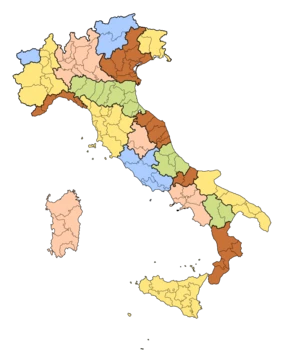
Umbria
Central Italian region, landlocked, named for the ancient Umbri.

Umbria is a region of central Italy, the only landlocked region on the Apennine Peninsula. The region is named for the Umbri people, an Italic people absorbed by Roman expansion, and is characterized by hills, mountains, forests, valleys, and historical towns including Assisi, a World Heritage Site associated with St. Francis of Assisi.
- Capital
- Perugia
- Area classification
- Landlocked region of central Italy
- Major rivers
- Tiber, Chiascio, Topino, Nera
- Notable features
- Lake Trasimeno, Marmore Falls
- Historical peoples
- Umbri, Etruscans, Romans
Lore & Background
The region is named for the Umbri people, an Italic people absorbed by Roman expansion. Unlike the Etruscans, the Umbri generally did not live in an urban society but occupied small dwellings in the Apennines. Pliny the Elder recounted a fanciful derivation of the tribal name from the Greek word for 'a shower,' leading to a claim that they survived the Deluge and were the most ancient race in Italy. Their language, Umbrian, was related to Latin and Oscan, and the Iguvine Tablets, found in Gubbio, are the longest and most important document of the Osco-Umbrian group of languages, written at the turn of the 2nd and 1st centuries BC. The Tiber river formed the border between Etruria and Umbria.
Reader's Guide
Umbria's significance lies in its role as a historical crossroads of Italic, Etruscan, and Roman civilizations, and later as a territory contested by Lombards, Byzantines, and the Papacy. The region's ancient Umbri people left a linguistic legacy through the Iguvine Tablets, while Roman development followed the via Flaminia. In the Middle Ages, the Duchy of Spoleto and autonomous communes shaped its political landscape, and the region was eventually subsumed into the Papal States. Modern Umbria emerged after the Italian Risorgimento, with its economy shifting from agriculture to industry through the Acciaierie di Terni steelworks. Its geography, as the only landlocked Italian region, and its preservation of historical towns like Assisi and Gubbio contribute to its cultural and historical importance.
Did You Know?
- Umbria is the only landlocked region on the Apennine Peninsula.
- The Iguvine Tablets, found in Gubbio, are the longest and most important document of the Osco-Umbrian group of languages.
- The comune of Città di Castello has an exclave named Monte Ruperto within Marche.
Geography & Identity
Umbria stands apart from every other region on the Apennine Peninsula as the sole landlocked territory, a fact that has shaped its insular character for millennia. Nestled in central Italy, it is threaded by the Tiber and cradles Lake Trasimeno and the dramatic Marmore Falls within its borders. The landscape is a patchwork of rolling hills, dense forests, deep valleys, and mountain ridges that give the area a distinctly rural, enclosed feel. Its capital, Perugia, serves as a university hub, while the surrounding towns—Assisi, Terni, Foligno, Norcia, Gubbio, Spoleto, Orvieto, Todi, Narni, and many others—dot the terrain like scattered jewels. Assisi carries the weight of a UNESCO World Heritage designation tied to St. Francis. Despite its cultural richness, Umbria remains modest in population, home to roughly 850,627 residents, making it the fourth least populous region in Italy. This combination of natural enclosure, historical depth, and relative quiet has long defined its identity.
The Umbri & Ancient Roots
The region takes its name from the Umbri, an Italic people whose way of life differed sharply from their Etruscan neighbors. Rather than building sprawling urban centers, the Umbri settled in small dwellings tucked into the Apennine highlands. Their language, Umbrian, belonged to the broader Italic family alongside Latin and Oscan. The most significant surviving text in any Osco-Umbrian tongue is the Iguvine Tablets, housed in Gubbio and dating to the turn of the second and first centuries BC. Pliny the Elder offered a fanciful etymology linking the tribal name to the Greek word for "shower," suggesting the Umbri had survived the mythic Deluge and thus claimed the title of Italy's oldest race. In reality, they likely descended from the Terramara and Proto-Villanovan cultures that entered northern and central Italy at the dawn of the Bronze Age. Their chief adversaries were the Etruscans, whose expansion between roughly 700 and 500 BC pushed the Umbrians further into the mountains and saw the capture of three hundred of their settlements, yet the population was never fully erased from the conquered lands.
Roman Conquest & Military Crossroads
Once the Etruscan threat receded, the Umbri found themselves drawn into Rome's expanding orbit. In 308 BC they lent their support to the Samnites against Roman power, but the decisive battle of Sentinum in 295 BC shattered that alliance, forcing allied Umbrian and Etruscan forces to retreat and defend their own territories. The Roman victory opened the door to systematic integration: colonies like Spoletium were planted, and the via Flaminia, completed in 219 BC, became the principal artery for Roman development across the region. During Hannibal's Second Punic War campaign, the battle of Lake Trasimene fell within modern Umbrian borders, though the local population refused to aid the Carthaginian invader. The Roman Civil War brought further devastation when Perugia, a supporter of Mark Antony, was nearly razed by Octavian in 40 BC. By Pliny's era, forty-nine independent communities still persisted, and the region supplied a high proportion of imperial army recruits. Under Augustus, Umbria was formally designated Regio VI of Roman Italy, though its boundaries differed markedly from the modern region.
Papal Dominion & the Road to Modern Italy
The post-Roman centuries saw Umbria caught between Ostrogothic and Byzantine ambitions, with a decisive clash fought near present-day Gualdo Tadino. The Lombards then carved out the duchy of Spoleto across much of the southern half, while the Byzantines retained a corridor along the Via Flaminia. Charlemagne's conquests redrew the map again, ceding portions of Umbrian territory to the Pope, who thereby established temporal authority over the land. In the early fourteenth century, powerful local signorie rose to prominence—the Vitelli in Città di Castello, the Baglioni in Perugia, and the Trinci in Foligno—before Cardinal Albornoz folded the region into the Papal States mid-century, paving the way for the papal return from Avignon. The fifteenth century saw Renaissance humanists revive the ancient name "Umbria" to replace the older "Ducato." Pope Paul III reinforced papal supremacy in the sixteenth century by erecting the Rocca Paolina fortress in Perugia. Papal rule went uncontested until the eighteenth century's close. The Napoleonic era briefly made Umbria the department of Trasimène, but after 1814 the Pope reasserted control until 1860, when Victor Emmanuel II annexed the region during the Risorgimento and Perugines tore down the Rocca Paolina as a symbol of papal authority.
Frequently Asked Questions
Who is Umbria?
Umbria is a landlocked region in central Italy, making it the only region on the Apennine Peninsula with no coastline. It takes its name from the ancient Umbri, an Italic people later absorbed into the Roman world, and its capital city is Perugia.
What are Umbria's powers/role?
Its defining traits are the rolling hills, dense forests, mountain valleys, and water features like Lake Trasimeno and the Marmore Falls. Major rivers including the Tiber, Chiascio, Topino, and Nera thread through its interior landscape.
How does Umbria's story end?
The ancient Umbri people were ultimately absorbed through Roman expansion, and the region's name survived as a geographic and cultural identity rather than a sovereign state. Today it exists as one of Italy's modern administrative regions, preserving Etruscan, Roman, and medieval heritage in towns like Assisi.
Why is Umbria important?
It is home to Assisi, a UNESCO World Heritage Site deeply tied to the legacy of St. Francis, and it holds the unique distinction of being Italy's sole landlocked region. Its compact size and rich layered history give it outsized cultural significance relative to its population.
More in Italian Regions 1-17
Spotted an error? Know more?
This is a living reference — every entry is fact-audited, and reader corrections feed straight into our audit queue. Suggest an edit · See this site's audit record