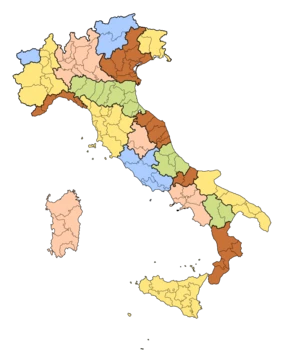
Liguria
North-western Italian region, former territory of the Republic of Genoa.

Liguria is a region of north-western Italy, with its capital at Genoa. Its territory is crossed by the Alps and the Apennines and is roughly coextensive with the former Republic of Genoa.
- Capital
- Genoa
- Borders
- France, Piedmont, Emilia-Romagna, Tuscany
- Sea
- Ligurian Sea
- Euroregion
- Alps–Mediterranean Euroregion
- Ancient People
- Ligures
- Historical State
- Republic of Genoa
Lore & Background
The name Liguria predates Latin and is of obscure origin, deriving from the ancient Ligures people, whose territory was much larger than the current region. The ancient Ligurians settled from the Rhone to the Arno, with tribes reaching as far as Spain. The Genoa area has been inhabited since the fifth or fourth millennium BC. After the war, it received municipal rights. Under Augustus, Liguria became Regio IX, stretching from the coast to the lower Po valley, though its northern boundary did not uniformly reach the Po. Between the 4th and 10th centuries, Liguria was dominated by Byzantines, Lombards, and Franks, and invaded by Saracen and Norman raiders. From the 11th to 15th centuries, the Republic of Genoa experienced extraordinary political and commercial success, becoming one of the most powerful maritime republics. Internal factions led to periods of rule by the Visconti family of Milan and the king of France.
Reader's Guide
Liguria's significance lies in its role as the heartland of the Republic of Genoa, a major maritime republic that dominated Mediterranean trade from the 12th to 14th centuries. Its capital, Genoa, was a key player in the Crusades and spice trade, with colonies extending to the Black Sea. The region's strategic position on the Ligurian Sea, bordered by the Alps and Apennines, shaped its history as a crossroads of cultures and powers. The legacy of the ancient Ligures, who gave the region its name, persists in the archaeological record, from prehistoric huts to copper mines. Genoese explorer Christopher Columbus, though supported by Spain, is a notable figure from this region. Today, Liguria is part of the Alps–Mediterranean Euroregion, reflecting its enduring geographic and cultural importance.
Did You Know?
- The name Liguria predates Latin and is of obscure origin, deriving from the ancient Ligures people.
Deep Roots: Prehistoric Liguria
Liguria's human story stretches back nearly 300,000 years. Near the port of Nice, in a site called Terra Amata, archaeologists uncovered the remains of oval huts with central hearths built by nomadic hunters, alongside chipped pebbles, scrapers, and the bones of wild boar, turtles, Merk's rhinoceros, southern elephants, and aurochs. The stratigraphy reveals multiple settlement periods. Neanderthal traces appear near Loano, while the Balzi Rossi cave in Ventimiglia holds remains reminiscent of Cro-Magnon Man. The Toirano caves show signs of Upper Palaeolithic frequentation, and the Arene Candide site preserves Neolithic and epigravettian layers between 20,000 and 18,700 years ago. Perhaps most strikingly, copper mining began in the region from the middle of the fourth millennium BC, with the Libiola and Monte Loreto mines dated to 3700 BC, making them the oldest known copper mines in the entire western Mediterranean basin. From the second millennium BC onward, the Ligurians inhabited a vast stretch of coastline, and Polybius records their presence from the Rhone to the Arno, with colonial influence reaching as far as the Spanish Mediterranean coast, the Tiber, and the shores of Corsica, Sardinia, and Sicily.
Stalia and the Roman Crucible
The area that would become Genoa was inhabited as early as the fifth or fourth millennium BC by the ancient Ligures. Excavations between 1898 and 1910 revealed that this Ligure population maintained active trade with both the Etruscans and the Greeks, as shown by artefacts from those cultures. In the fifth century BC, the first settlement, an oppidum, was established atop the hill now called Castello, within today's medieval old town. The ancient city was known as Stalia, referenced by both Artemidorus Ephesius and Pomponius Mela, and possibly preserved in the nearby name Staglieno. During the Second Punic War, Stalia held a foedus aequum, an equal pact, with Rome. The Carthaginians destroyed the town in 209 BC, but it was rebuilt and, once the Carthaginian Wars ended in 146 BC, granted municipal rights. Under Augustus, Liguria was formally designated Regio IX, stretching from the coast to the Po River. The great Roman roads, the Aurelia and Julia Augusta along the coast and the Postumia and Aemilia Scauri heading inland, strengthened territorial cohesion and boosted trade. In 180 BC, Rome deported 47,000 Liguri Apuani to the Samnite area between Avellino and Benevento.
The Republic and the Sea
Between the fourth and tenth centuries, Liguria passed successively under Byzantine, Lombard, and Frankish rule, and was also raided by Saracens and Normans. Once the pirate threat receded in the tenth century, the territory was organized into three marches: Obertenga in the east, Arduinica in the west, and Aleramica in the centre. Over the eleventh and twelfth centuries, these marches fragmented into fees, and the growing power of bishops gradually weakened the feudal structure. Coastal towns, in particular, evolved into independent city-states, and Genoa soon extended its dominance over them. Inland, however, noble family fiefs persisted for centuries. The Republic of Genoa then entered an extraordinary era of political and commercial success spanning from the eleventh through the fifteenth centuries. Genoese ships played a major role in the First Crusade, transporting knights and troops to the Middle East for a fee. The republic became one of the most powerful maritime states in the Mediterranean from the twelfth to the fourteenth century, building its wealth largely on spice trade with the Orient.
Name, Land, and Identity
The very name Liguria predates Latin and remains of obscure origin. The Latin adjectives Ligusticum and Liguscus point to an original root, ligusc-, in which the -sc- was shortened to -s- and later transformed into the -r- of Liguria through a process called rhotacism. Ancient Greek preserves the form Lígus, meaning a person from Liguria, and the place name Ligustikḗ. The territory takes its name from the ancient Ligures people, whose domain was far larger than today's administrative region, encompassing all of north-western Italy south to the Po River and extending into south-eastern France. The modern region sits in north-western Italy, its capital Genoa, bordered by France's Provence-Alpes-Côte d'Azur to the west, Piedmont to the north, and Emilia-Romagna and Tuscany to the east. Its territory is crossed by both the Alps and the Apennines, and it rests on the Ligurian Sea. Liguria is part of the Alps-Mediterranean Euroregion and has a population of approximately 1,511,988 as of 2026. Its territory is roughly coextensive with the former domain of the Republic of Genoa.
Frequently Asked Questions
What is Liguria's role in the region lineup?
Liguria occupies a narrow corridor where the Alps press down from the north and the Apennines rise from the south, making it Italy's classic mountain-meets-sea region. It also holds a seat in the Alps–Mediterranean Euroregion, bridging Alpine and Mediterranean communities.
Who are Liguria's neighbors?
Liguria shares land borders with France to the west, Piedmont to the north, Emilia-Romagna to the east, and Tuscany to the south. Its western and southern edges open directly onto the Ligurian Sea.
What is Liguria's origin story?
The region takes its name from the ancient Ligures people who once roamed the area. Its political identity was forged over centuries by the Republic of Genoa, a maritime power that shaped Mediterranean trade routes.
More in Italian Regions 1-17
Spotted an error? Know more?
This is a living reference — every entry is fact-audited, and reader corrections feed straight into our audit queue. Suggest an edit · See this site's audit record