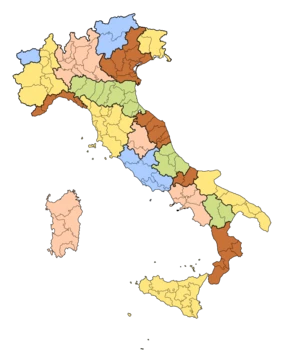
Veneto
Region of Italy, former core of the Republic of Venice.

Veneto is one of the 20 regions of Italy, located in the north-east. Venice is the capital, while Verona is the largest city.
- region
- Veneto
- country
- Italy
- capital
- Venice
- largest_city
- Verona
- official_language
- Italian
- regional_language
- Venetian
Lore & Background
Between the 2nd and 1st millennium BC, the region was inhabited by the Euganei. Ancient historians linked the Veneti to the legend of Troy, claiming they came from Paphlagonia led by prince Antenor. Other historians link Venetic origins with Celts. In the 7th–6th centuries BC, local populations contacted Etruscans and Greeks. The Veneti spoke Venetic, an Indo-European language akin to but distinct from Latin. They prospered through amber trade and horse breeding. By the end of the 1st century AD, Latin had displaced Venetic. The region suffered invasions by Quadi, Marcomanni, Huns, Ostrogoths, and Lombards.
Reader's Guide
Veneto's significance lies in its long history as a core territory of the Republic of Venice, one of the largest and richest maritime republics and trade empires in the world. The region's modern identity is shaped by its Venetian language and a notable nationalist movement, Venetian nationalism or Venetism.
Did You Know?
- Besides Italian, most inhabitants also speak Venetian.
Ancient Roots of the Venetic World
Between the second and first millennia before the common era, the lands that would become Veneto were shaped by the Euganei and, according to ancient historians, by the Palaeoveneti—peoples whose origins were traced to Paphlagonia in Anatolia, arriving in the twelfth century BC under a prince named Antenor, a companion of Aeneas. Other scholars instead linked their ancestry to Celtic stock. By the seventh and sixth centuries BC, these communities were in contact with both Etruscans and Greeks, and their culture reached a peak during the fourth century BC. The Veneti spoke their own Indo-European tongue, distinct from Latin and the other Italic languages, and built prosperity on amber trade and horse breeding. Cities such as Este, Padua, Oderzo, Adria, Vicenza, Verona, and Altino served as cultural hubs. Over time, the Veneti gradually absorbed the dress and certain customs of their Celtic neighbors, blending identities in a way that would echo through centuries of regional self-consciousness.
Roman Conquest and the Forging of Infrastructure
The Veneti's relationship with Rome began as an alliance. During the Second Punic War, they dispatched soldiers to fight alongside Roman forces against Hannibal's Carthaginian army, and many of those warriors perished at the Battle of Cannae in 216 BC. In 181 BC, a Roman triumvirate established a Latin colony at Aquileia to shield Venetic territory from hostile Carni and Histri incursions, and by 169 BC an additional 1,500 colonising families had been sent there. The completion of the Via Postumia in 148 BC, linking Aquileia to Genoa, and the Via Annia in 131 BC, connecting Adria through Padua to Aquileia, wove the region into Rome's arterial network. Citizenship was extended in stages: partial rights in 91 BC, full citizenship in 49 BC. Augustus later folded the territory into Region X, Venetia et Histria, and under the Pax Romana, Padua grew into one of northern Italy's most significant cities. By the end of the first century AD, Latin had fully displaced the original Venetic language.
From Maritime Republic to Modern Region
For centuries, Venice commanded one of the largest and wealthiest maritime republics and trade empires in the world, governing the Veneto until 1797. The Napoleonic Wars and the Congress of Vienna then reshaped the political map: the former Republic was merged with Lombardy and re-annexed to the Austrian Empire as the Kingdom of Lombardy–Venetia. That arrangement lasted until 1866, when the Third Italian War of Independence and a popular plebiscite brought the territory into the Kingdom of Italy. Today, Veneto ranks as the fourth most populous Italian region, home to nearly 4.86 million people, with Venice serving as capital and Verona as the largest city. The region's political identity remains distinctive: the Statute of Veneto, in force since 1971, defines its citizens as "the Venetian people" and affirms their right to self-government, yet Veneto does not enjoy the special autonomous status granted to neighboring Friuli-Venezia Giulia or Trentino-Alto Adige/Südtirol.
Identity, Nationalism, and Demographic Transformation
Venetian nationalism, or Venetism, represents a persistent political current in the region. Liga Veneta, the largest party in Veneto and a founding component of Lega Nord, channels much of this sentiment. Alberto Stefani, representing the Liga Veneta–Lega Nord coalition, was elected President of Veneto in 2025. In 2017, a non-binding autonomy referendum saw 57.2% of eligible voters turn out, with a striking 98.1% voting in favor of "further forms and special conditions of autonomy." Linguistically, most inhabitants speak Venetian alongside Italian, reinforcing a sense of distinct cultural identity. Demographically, the region has undergone a remarkable reversal: once a land of mass emigration, Veneto is now among Italy's greatest recipients of immigration, with foreign-born residents comprising 13.9% of the population—the seventh-highest share among all Italian regions.
Frequently Asked Questions
What are Veneto's powers/role?
Veneto was the political heart of the Republic of Venice, which for centuries ran one of the largest and wealthiest maritime trade networks in the world. That legacy left the region with a deep cultural identity built around seafaring commerce, diplomacy, and artistic patronage.
Why is Veneto important?
As Italy's fourth most populous region, Veneto carries major economic and demographic weight. Its centuries as a dominant Mediterranean trading power also shaped broader European commerce, diplomacy, and the arts.
Why is Venice the capital when Verona is bigger?
Venice was chosen as the seat of regional government to honor the area's historic identity as the capital of the old maritime republic. Verona, while the most populous urban center, grew up as a mainland city and never held that same symbolic role.
More in Italian Regions 1-17
Spotted an error? Know more?
This is a living reference — every entry is fact-audited, and reader corrections feed straight into our audit queue. Suggest an edit · See this site's audit record