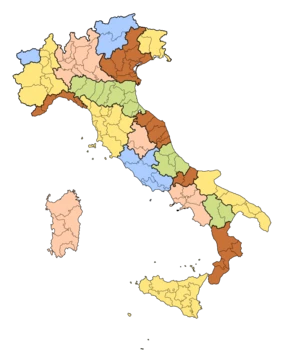
Calabria
Southern Italian region, ancient heart of Magna Graecia.

Calabria is a region in Southern Italy, forming the 'toe' of the Italian Peninsula. It is a peninsula bordered by Basilicata to the north, the Ionian Sea to the east, the Strait of Messina to the southwest, and the Tyrrhenian Sea to the west. Calabria is the birthplace of the name of Italy, given by the Ancient Greeks who settled there from the 8th century BCE, making it the heart of Magna Graecia and home to figures such as Pythagoras, Herodotus, and Milo. The region later became a Byzantine dominion for five centuries, fully recovering its Greek character, and was a major silk production area in Europe.
- Capital
- Catanzaro
- Historical Ethnolinguistic Minorities
- Grecanici (Calabrian Greek), Arbëreshë (Albanian), Occitans of Guardia Piemontese
- National Parks
- Pollino National Park (largest in Italy), Sila National Park, Aspromonte National Park
Lore & Background
Calabria's name originally referred to the Adriatic coast of the Salento peninsula in modern Apulia from the third century BCE. Under Emperor Augustus, the name extended to all of Salento, while modern Calabria was known as Bruttium. In the seventh century AD, the Byzantine Empire created the Duchy of Calabria from Salento and the Ionian part of Bruttium; after Lombard conquests, the Byzantines retained the name for their remaining territory in Bruttium. The Greeks originally used 'Italoi' for the native population of modern Calabria, derived from a legendary king of the Oenotri, Italus, and later extended the term to the rest of southern Italy and eventually the entire peninsula.
Reader's Guide
Calabria's significance lies in its role as the cradle of the name 'Italy' and as a core region of Magna Graecia, where Greek colonies flourished from the 8th century BCE. Its Byzantine period, lasting five centuries, preserved Greek culture and made it Europe's leading silk producer. The region's linguistic diversity—with Grecanici, Arbëreshë, and Occitan minorities—makes it a focus for linguists. Geographically, Calabria features three national parks, including Italy's largest, the Pollino National Park, and is known for its crystal clear seas, ancient villages, castles, and archaeological parks. The etymology of its name reflects a complex historical shift from Apulia to its current location, illustrating the region's layered past.
Did You Know?
- Calabria is the birthplace of the name of Italy, given by the Ancient Greeks.
- The region was a Byzantine dominion for five centuries and became the main silk production area in Europe.
- Calabria has three historical ethnolinguistic minorities: Grecanici, Arbëreshë, and Occitans.
- The Pollino National Park in Calabria is the largest national park in Italy.
The Name That Named a Nation
The story of how Calabria gave its name to all of Italy is one of the most remarkable linguistic journeys in European history. Beginning in the third century BCE, the term Calabria was actually applied to the Adriatic coast of the Salento peninsula in what is now Apulia. It was not until the late first century BCE, when Emperor Augustus reorganized Italy into administrative regions, that the name stretched to cover the entire Salento area, creating Regio II Apulia et Calabria. Meanwhile, the land we now call Calabria was still known as Bruttium, named after the Bruttians who inhabited it. The Byzantines, in the seventh century AD, created a Duchy of Calabria from the Salento and the Ionian portion of Bruttium. Even after the Lombards took the Calabrian portion of that duchy in the eighth and ninth centuries, the Byzantines kept using the name for their remaining territory. The Greeks originally used Italoi for the native Calabrian population, a word possibly derived from a legendary king Italus of the Oenotri. Over time, that term expanded to cover the whole southern peninsula, then the entire Italian peninsula, and eventually the Alpine regions as well.
A Landscape of Peaks and Pines
Calabria forms the toe of the Italian Peninsula, a long, narrow strip stretching about 248 kilometres from north to south with a maximum width of just 110 kilometres. The terrain is rugged: mountains claim about 42 percent of the region's area, hills another 49 percent, leaving only a slim 9 percent for plains. Three major ranges define the landscape. The Pollino Mountains in the north act as a natural barrier separating Calabria from the rest of Italy, hosting a rare Bosnian Pine variety and encompassing the Pollino National Park, Italy's largest at nearly 1,926 square kilometres. La Sila, often called the Great Wood of Italy, is a vast plateau sitting around 1,200 metres above sea level, stretching nearly 2,000 square kilometres through the central region. Its highest point, Botte Donato, rises to 1,928 metres. The area is home to some of Italy's tallest trees, the Giants of the Sila, which can tower to 40 metres, and its Sila National Park is reputed to hold the purest air in Europe. At the southern tip, the Aspromonte massif, bordered by sea on three sides, peaks at Montalto, 1,995 metres, and is covered in wide man-made terraces sloping toward the water.
Five Centuries of Byzantine Light
After the Gothic War, Calabria entered a remarkable five-century period under Byzantine rule, during which it fully recovered its Greek character. This era saw the flourishing of cenobitism, as Basilian monks established churches, hermitages, and monasteries throughout the peninsula, dedicating themselves to the careful transcription of texts. The Byzantines also introduced the art of silk production to Calabria, making it the principal silk-producing area in all of Europe. Before this Byzantine chapter, the region had already been the heart of Magna Graecia. Starting in the eighth century BCE, Ancient Greeks settled the coast and founded the first cities as colonies, producing key figures in history such as Pythagoras, Herodotus, and Milo. In Roman times, the territory was incorporated into Regio III Lucania et Bruttii within Augustan Italy. The Norman conquest of the eleventh century then set in motion a slow process of Latinization that gradually reshaped the region's cultural and linguistic identity.
Three Languages, One Peninsula
Few regions in Europe can claim the extraordinary linguistic tapestry that Calabria harbours. The region is home to three distinct historical ethnolinguistic minorities, each preserving a language that stands apart from the surrounding Italian. The Grecanici people speak Calabrian Greek, a living remnant of the region's deep Greek heritage. The Arbëreshë community carries the Albanian language, a distinctive presence in the southern Italian landscape. And in the small town of Guardia Piemontese, a pocket of Occitans maintains its own linguistic heritage. This remarkable concentration of diverse languages in a single peninsula makes Calabria an object of study for linguists from all over the world. The coexistence of Greek, Albanian, and Occitan alongside Italian within a few hundred kilometres of coastline and mountain is a phenomenon that draws scholarly attention and underscores the depth of Calabria's layered history.
Frequently Asked Questions
What is Calabria's role in the overall story?
Calabria is the ancient heart of Magna Graecia, the place where Greek colonists landed in the 8th century BCE and actually coined the very name 'Italy.' It nurtured towering figures such as Pythagoras, Herodotus, and Milo of Croton, making it a foundational origin character for the entire peninsula's identity.
How does Calabria's story evolve over time?
After its Greek golden age, Calabria spent about five centuries under Byzantine rule, a period in which it fully reclaimed its Greek cultural character. It then transitioned into a major silk-producing center before eventually settling into its modern identity as a southern Italian region.
Why is Calabria important to the broader narrative?
Without Calabria, the name 'Italy' would never have existed, since the Greek settlers there were the first to use that term for the land. The region also anchors southern ecology with three national parks, including Pollino, which is the largest protected area in all of Italy.
What hidden factions or minorities does Calabria shelter?
Calabria protects several rare ethnolinguistic communities, including the Grecanici who still speak a living Calabrian Greek dialect, the Arbëreshë of Albanian descent, and the Occitans of Guardia Piemontese. These groups add deep cultural layers that set the region apart from its neighbors.
More in Italian Regions 1-17
Spotted an error? Know more?
This is a living reference — every entry is fact-audited, and reader corrections feed straight into our audit queue. Suggest an edit · See this site's audit record