Campania
Campania is a densely populated, economically productive region in southern Italy.

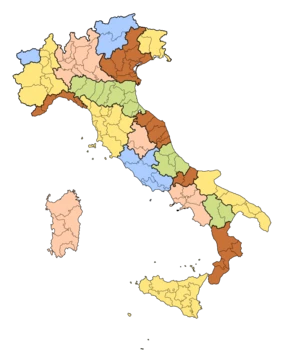
Campania is an administrative region of Italy, located in the south of the country, most of it in the southwestern portion of the Italian Peninsula with the Tyrrhenian Sea to its west. It includes the Phlegraean Islands (Ischia, Procida, Vivara, and Nisida) and the island of Capri, with Naples as its capital. Based on its GDP, Campania is the most economically productive region in Southern Italy and the 7th most productive in the whole country, and Naples' urban area is the seventh most populous in the European Union. The region is home to 10 of the 58 UNESCO sites in Italy, including Pompeii, Herculaneum, the Royal Palace of Caserta, the Amalfi Coast, the Longobardian Church of Santa Sofia in Benevento, and the Historic Centre of Naples, and Mount Vesuvius is part of the UNESCO World Network of Biosphere Reserves. Campania plays a key international role in diplomacy, hosting NATO's Allied Joint Force Command Naples and the Parliamentary Assembly of the Mediterranean.
- Capital
- Naples
- Region rank by population
- 3rd in Italy
- Region rank by density
- 2nd in Italy
- GDP rank in Southern Italy
- 1st
- GDP rank in Italy
- 7th
Lore & Background
The region known today as Campania was inhabited from at least the beginning of the 1st millennium BC by several Oscan-speaking Italic tribes, including the Osci, Opici, Aurunci, Ausones, Sidicini, Hirpini, Caudini, Oenotrians, Campanians, and Lucanians. Between the 9th and 6th centuries BC, the Etruscans established colonies in the Campanian Plains and other areas, founding cities such as Hyria (Nola), Irnthi (Salerno), and Amina (Pontecagnano), and incorporating pre-existing Oscan agro-towns like Capua, Nuceria, and Pompeii. During the 8th century BC, Hellenes from Euboea, known as Cumaeans, established colonies along the coastal areas, founding Cumae, Pithekoūsai (Ischia), Paestum, Herculaneum, and Dicaearchia (Pozzuoli), while Naples began as a small commercial port called Parthenope, established by Greek colonial sailors from Rhodes. The region thus became one of the centers of Magna Graecia.
Reader's Guide
Campania's significance stems from its role as a cultural and economic hub in southern Italy, with a history shaped by Oscan, Etruscan, Greek, and Roman influences. The region was a full-fledged part of the Roman Republic by the end of the 4th century BC, valued for its pastures and rich countryside, and Naples became a centre of Hellenistic culture for the Romans. During the Roman Empire, Campania, with Latium, formed the most important region of the Augustan divisions of Italia, and was one of the main areas for granary. The eruption of Mount Vesuvius in 79 buried Pompeii and Herculaneum, preserving them as major archaeological sites. In the Middle Ages, the area had many duchies and principalities under the Byzantine Empire and the Lombards, and later under the Normans, the smaller independent states were brought together as part of the Kingdom of Sicily, before the mainland broke away to form the Kingdom of Naples. Today, Campania's rich natural beauty and cultural heritage make it important to the tourism industry, with Naples, the Amalfi Coast, Mount Vesuvius, and the islands of Capri and Ischia as major attractions.
Did You Know?
- Campania is home to 10 of the 58 UNESCO sites in Italy, including Pompeii, Herculaneum, the Royal Palace of Caserta, the Amalfi Coast, and the Historic Centre of Naples.
- Mount Vesuvius, located in Campania, is part of the UNESCO World Network of Biosphere Reserves.
- The name 'Campania' derives from Latin; the Romans knew the region as Campania felix ('fertile countryside' or 'happy countryside').
- Campania hosts NATO's Allied Joint Force Command Naples and the Parliamentary Assembly of the Mediterranean.
Geography, Population & Economic Standing
Campania occupies the southwestern sweep of the Italian Peninsula, its western coastline washed by the Tyrrhenian Sea, and extends beyond the mainland to a cluster of islands—Ischia, Procida, Vivara, Nisida, and the storied Capri. Naples anchors the region as its capital, and the city's metropolitan area ranks as the seventh most populous in the European Union. With approximately 5.57 million inhabitants distributed across roughly 13,671 square kilometres, Campania stands as Italy's third most populous and second most densely settled region. In economic terms, it commands the top GDP position among all of Southern Italy and holds the seventh spot nationwide. This convergence of dense settlement, prime coastal geography, and outsized economic output cements Campania as a critical node in both domestic Italian life and wider Mediterranean affairs.
Cultural Heritage & UNESCO Designations
Few places on Earth rival Campania's density of world-class heritage. Ten of Italy's fifty-eight UNESCO World Heritage Sites fall within its borders, a staggering concentration that includes the ash-preserved cities of Pompeii and Herculaneum, the grand Royal Palace of Caserta, the cliff-hugging Amalfi Coast, the Longobardian Church of Santa Sofia in Benevento, and the vast Historic Centre of Naples. Mount Vesuvius itself is inscribed in the UNESCO World Network of Biosphere Reserves. Beyond these formal designations, the landscape teems with further archaeological sites—Oplontis, Paestum, Aeclanum, Stabiae, and Velia—while a vibrant living tradition of food, music, and architecture continues to define daily life. This palimpsest of ancient and modern culture makes Campania one of the world's richest open-air museums.
Pre-Roman Inhabitants & the Greek Colonisation
From at least the first millennium BC, Campania's interior was dotted with Oscan-speaking Italic tribes—the Osci, Opici, Aurunci, Ausones, Sidicini, Hirpini, Caudini, Oenotrians, Campanians, and Lucanians—who dwelt in modest agro-towns. Between the ninth and sixth centuries BC, Etruscan colonists transplanted their Dodecapolis political model across the Campanian Plains, founding cities such as Hyria (modern Nola) and Amina (modern Pontecagnano) while absorbing older Oscan settlements including Capua, Pompeii, and Stabiae. In parallel, Greek colonists from Euboea planted coastal cities like Cumae, Paestum, and Herculaneum, and Rhodian sailors established the tiny port of Parthenope, the embryonic Naples. These overlapping waves of settlement turned Campania into a central theatre of Magna Graecia, where Greek, Etruscan, and Italic worlds intermingled across some of the peninsula's most fertile ground.
Roman Conquest & Modern Strategic Role
The Samnite Wars of the fourth century BC pulled Campania irrevocably into Rome's sphere. When the more martial Samnites seized prosperous cities like Capua and Cumae, the Etruscan-influenced Oscan city of Capua called on Rome for defence, igniting the First Samnite War. The Greek colony of Neapolis, left as the last major independent settlement, eventually allied with Rome after Samnite capture, triggering the Second Samnite War. Roman consul Quintus Publilius Filo recaptured the city by 326 BC and allowed it to keep its Greek identity as a civitas foederata, making Naples the first crucible where Hellenistic and Roman cultures blended. By the century's end, Campania was fully woven into the Republic, prized for its pastures and rich countryside. That strategic centrality persists into the modern era: Naples now hosts NATO's Allied Joint Force Command and the Parliamentary Assembly of the Mediterranean, anchoring Campania in contemporary international diplomacy.
Frequently Asked Questions
Who is Campania?
Campania is an administrative region in southern Italy, with Naples serving as its capital city. It encompasses a stretch of the Tyrrhenian coastline plus several islands, including Capri, Ischia, Procida, Vivara, and Nisida.
What is Campania's role in Italy?
Campania holds the top spot for economic output among all Southern Italian regions and ranks seventh nationally by GDP. It also stands as the country's second most densely populated region.
Where exactly is Campania located?
The region sits in the southwestern portion of the Italian Peninsula, bordered by the Tyrrhenian Sea to its west. Its territory extends offshore to include the Phlegraean Islands and the island of Capri.
Why is Campania considered important?
Campania anchors Southern Italy's industrial and commercial activity while maintaining a population density that places it second nationally. Its blend of mainland territory and coastal islands gives it a distinctive geographic and cultural footprint within the nation.
More in Italian Regions 1-17
Spotted an error? Know more?
This is a living reference — every entry is fact-audited, and reader corrections feed straight into our audit queue. Suggest an edit · See this site's audit record