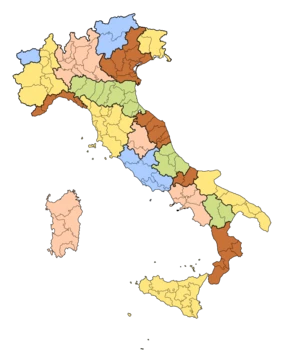
Lombardy
Lombardy is Italy's most populous and economically leading region.

Lombardy is an administrative region of Italy located in northern Italy, between the Alps mountain range and tributaries of the river Po. It is the most populous region of Italy, with a population of about 10 million, constituting more than one-sixth of Italy's population, and its capital and largest city is Milan. The region ranks first in Italy in terms of population, population density, and number of municipalities, and is typically the second-most populous region of the European Union after Île-de-France. Lombardy is the leading region of Italy in terms of economic importance, contributing to approximately one-fifth of the national gross domestic product, and Milan is the economic capital of Italy and a global centre for business, fashion, and finance.
- UNESCO World Heritage Sites
- 10
Lore & Background
During the Early Middle Ages, 'Lombardy' referred to the Kingdom of the Lombards, which controlled most of early Christian Italy except the Papal possessions, Venice, and some Byzantine possessions. The Lombard culture is foundational to Italy in the Middle Ages. The region has been settled since at least the second millennium BC, with evidence of the Golasecca Bronze Age culture and later Celtic tribes, before becoming the Roman province of Gallia Cisalpina.
Reader's Guide
Lombardy's significance lies in its historical role as the heart of the Kingdom of the Lombards, which shaped early medieval Italy, and its later emergence as a center of the Renaissance through the Duchy of Milan and Mantua. The region's economic importance is paramount, as it contributes roughly one-fifth of Italy's GDP and is home to Milan, a global hub for business, fashion, and finance. Lombardy is also a member of the Four Motors for Europe, alongside Baden-Württemberg, Catalonia, and Auvergne-Rhône-Alpes. Culturally, it boasts 11 UNESCO World Heritage Sites, tying it with Castile and León. The Lombard League, formed by allied cities in the 12th and 13th centuries, is considered one of the first examples of a confederation in Europe. The term 'Lombard' historically designated merchants or bankers from northern Italy, as seen in Lombard Street, London.
Did You Know?
- Lombardy is typically the second-most populous region of the European Union after Île-de-France.
- The name 'Lombardy' comes from the Lombards, whose name may derive from Proto-Germanic elements meaning 'long beard' or 'axe'.
- Lombardy has 10 UNESCO World Heritage Sites, while Castile and León in Spain has 12.
Geography, Population, and Administrative Structure
Lombardy stretches across 23,844 square kilometers in northern Italy, positioned between the Alpine mountain range and the tributaries that feed the Po River. Although it ranks only fourth in surface area—behind Sicily, Piedmont, and Sardinia—it is the most densely populated region in the country, housing roughly ten million residents, which represents more than one-sixth of Italy's total population. This density makes it the second-most populous region in the entire European Union. The territory is divided into an extraordinary 1,501 municipalities, the highest number of any region in the national territory, organized under twelve administrative subdivisions: eleven traditional provinces plus the Metropolitan City of Milan. Milan serves as both the capital and the largest city, and its metropolitan area is the largest in Italy and among the largest in the EU. The sheer number of small local governments reflects a deeply rooted tradition of municipal self-governance spread across a compact but diverse landscape.
Economic Engine and European Standing
Lombardy is the undisputed economic engine of Italy, contributing approximately one-fifth of the nation's gross domestic product. It holds the distinction of being the second region in the European Union by nominal GDP, a figure that speaks to the sheer scale of its commercial and industrial output. Milan, the region's capital, operates as Italy's economic capital and a globally recognized center for business, fashion, and finance. The region's economic influence reaches well beyond national borders: it is a member of the Four Motors for Europe, an international economic organization whose other members include Baden-Württemberg in Germany, Catalonia in Spain, and Auvergne-Rhône-Alpes in France. This grouping highlights Lombardy's role as one of the continent's most dynamic commercial zones. The combination of a massive and densely concentrated population, a highly fragmented municipal structure of over fifteen hundred local governments, and world-class urban centers creates an economic ecosystem that is simultaneously concentrated in major hubs and dispersed across a wide rural and suburban landscape.
A Layered History from Prehistory to the Middle Ages
Human habitation in what is now Lombardy dates back at least to the second millennium BC, as shown by ceramics, arrowheads, axes, and carved stones recovered by archaeologists. Among the most striking discoveries are the rock engravings of the ancient Camuni people in Valcamonica, depicting animals, humans, and abstract symbols, produced over eight thousand years before the Iron Age and recorded in approximately 300,000 entries. The Golasecca Bronze Age culture thrived in the western part of the region between the ninth and fourth centuries BC, followed by Etruscan settlers who founded Mantua and spread the use of writing. Successive waves of Celtic Gallic tribes arrived from beyond the Alps, establishing cities including Milan and extending their reach to the Adriatic coast. Roman expansion from the third century BC eventually absorbed the entire area into the province of Gallia Cisalpina. The region produced luminous figures such as Pliny the Elder in Como and Virgil in Mantua, and in 313 AD, Emperor Constantine issued the Edict of Milan from the city, granting freedom of religious confession throughout the empire. The Germanic Lombards arrived in 568, established Pavia as their capital, and ruled until Charlemagne's conquest in 774.
Etymology, Identity, and UNESCO Heritage
The very name Lombardy carries the imprint of its medieval conquerors. It derives from the Late Latin Longobardus, itself built from Proto-Germanic elements meaning long beard, though some scholars trace the second component to a root meaning axe, related to the modern German word Barte. The region took its name from the Lombard people who invaded Italy in 568 and established the Kingdom of the Lombards, a polity that for nearly two centuries was almost interchangeable with Italy itself, as the Lombards controlled most of the peninsula outside the Papal States, Venice, and scattered Byzantine holdings. Their culture merged with the Gallo-Roman population, leaving lasting traces in place names, legal codes, and the broader medieval Italian identity. Today, Lombardy's cultural depth is reflected in its extraordinary UNESCO record: eleven of Italy's fifty-eight World Heritage Sites are located within its borders, a tally that ties it with Spain's Castile and León. This concentration of globally recognized heritage speaks to millennia of continuous human creativity, from the prehistoric engravings of Valcamonica to the architectural and artistic achievements that define the region's landscape to this day.
Frequently Asked Questions
Who is Lombardy?
Lombardy is one of Italy's administrative regions situated in the northern part of the country. It is home to roughly ten million residents, making it the most populous region in all of Italy.
What is Lombardy's role in the Italian economy?
The region is widely considered the economic engine of the nation, generating a disproportionately large share of national output. Its capital, Milan, anchors Italy's finance, industry, and fashion sectors.
Where exactly is Lombardy located geographically?
It stretches between the Alpine mountain range to the north and the tributaries of the Po River to the south, placing it squarely in the northern heartland of Italy.
What is Lombardy's capital and largest city?
Milan holds both titles, serving as the region's administrative seat and its most densely populated urban center. The city also ranks among the most populous municipalities in the entire European Union.
Why is Lombardy important in the broader EU context?
It typically ranks as the second-most populous region in the European Union, trailing only Île-de-France. With ten UNESCO World Heritage Sites within its borders, it also carries considerable cultural significance.
More in Italian Regions 1-17
Spotted an error? Know more?
This is a living reference — every entry is fact-audited, and reader corrections feed straight into our audit queue. Suggest an edit · See this site's audit record