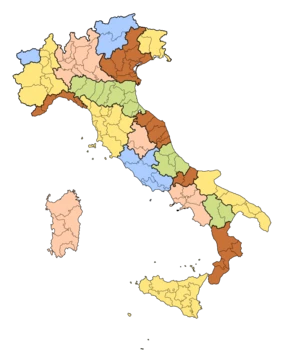
Lazio
Central Italian region, home to Rome and ancient Latium.

Lazio, also known as Latium, is one of the 20 administrative regions of Italy, situated in the central peninsular section of the country. The capital of Lazio is Rome, which is also the capital city of Italy. Lazio was the home of the Etruscan civilization, then stood at the center of the Roman Republic, of the Roman Empire, of the Papal States, of the Kingdom of Italy and of the Italian Republic. It boasts a rich cultural heritage, with great artists and historical figures having lived and worked in Rome, particularly during the Italian Renaissance period.
- Capital
- Rome
- Region type
- Administrative region of Italy
- Largest city
- Rome
Lore & Background
After the Gothic conquest of Italy at the end of the fifth century, modern Lazio became part of the Ostrogothic Kingdom, and after the Gothic War and conquest by the Byzantine Empire, the region became the Duchy of Rome. The strengthening of the religious and ecclesiastical aristocracy led to continuous power struggles between secular lords and the Pope until the middle of the 16th century. Lazio was part of the short-lived Roman Republic, after which it became a puppet state of the First French Republic under Napoleon Bonaparte.
Reader's Guide
Lazio's significance lies in its central role in Italian and European history. As the home of the Etruscan civilization, the Roman Republic, the Roman Empire, the Papal States, the Kingdom of Italy, and the Italian Republic, it has been a political and cultural nexus for millennia. The region's capital, Rome, served as the heart of these entities, making Lazio a repository of immense cultural heritage. Today, Lazio is a large center of services and international trade, industry, public services, and tourism, supported by an extensive network of transport infrastructures due to its geographical position in the center of the Italian Peninsula and the presence of Rome. Its economy is the second largest in Italy, and its population is the second highest, reflecting its enduring importance. The region's geography, from the coastal plains to the volcanic lakes and Apennine mountains, has shaped its history and development. Lazio's legacy includes not only the physical remnants of ancient civilizations but also the continuous evolution of governance, from Roman republic to modern Italian region, and its role as a focal point for art, religion, and politics.
Did You Know?
- Lazio's name may derive from the Latin word 'latus', meaning 'wide', referring to flat land.
- The emperor Augustus divided Italy into eleven regions, with part of Lazio becoming Region I (Latium et Campania).
Frequently Asked Questions
What is Lazio?
Lazio is one of Italy's twenty administrative regions, located in the central part of the peninsula. It is best known as the region that contains Rome, the nation's capital city.
What is Lazio's capital and largest city?
Rome serves as both the capital of the Lazio region and the capital of Italy itself. It is by far the region's most populous and economically dominant city.
Which major civilizations were historically centered in Lazio?
The region was the heartland of the Etruscan culture and later the cradle of the Roman Republic and the Roman Empire. It also housed the Papal States before becoming part of the unified Kingdom of Italy.
Why is Lazio considered so important in Italian history?
Lazio sits at the geographic and cultural crossroads of central Italy and has served as the political center for nearly every major Italian state since antiquity. Its status as home to Rome gives it a uniquely symbolic and administrative role in the country.
More in Italian Regions 1-17
Spotted an error? Know more?
This is a living reference — every entry is fact-audited, and reader corrections feed straight into our audit queue. Suggest an edit · See this site's audit record