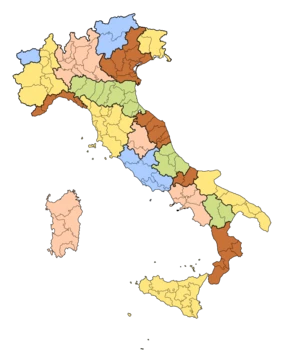
Emilia-Romagna
Wealthy Italian region with ancient university and automotive heritage.

Emilia-Romagna is an administrative region of northern Italy, comprising the historical regions of Emilia and Romagna, with its capital in Bologna.
- Capital
- Bologna
- Population
- over 4.4 million
- GDP per capita
- third highest in Italy
- Notable cities
- Modena, Ferrara, Ravenna
- UNESCO sites
- Modena, Ferrara, Ravenna
Lore & Background
In the 16th century, most of the region was seized by the Papal States, though Parma, Piacenza, and Modena remained independent until Italian unification. During World War II, the region was occupied by Germany and saw Nazi war crimes such as the Marzabotto massacre.
Reader's Guide
Emilia-Romagna holds significance as one of Europe's wealthiest and most developed regions, with the third highest GDP per capita in Italy. Its cultural importance is underscored by the University of Bologna, the oldest university in the world, and UNESCO World Heritage Sites in Modena, Ferrara, and Ravenna. The region is a global center for food and automobile production, including brands like Ferrari, Lamborghini, and Maserati, and features coastal resorts such as Cervia, Cesenatico, and Rimini. Its history spans from Etruscan and Roman times through Lombard and Byzantine rule, the Holy Roman Empire, and the Papal States, culminating in Italian unification.
Economic & Cultural Powerhouse
Emilia-Romagna stands as one of the most prosperous and developed territories in all of Europe, ranking third in Italy for gross domestic product per capita. Home to more than 4.4 million people spread across roughly 22,500 square kilometres, the region punches well above its weight in both industry and intellect. It is the birthplace of the University of Bologna, the oldest university in the world, and hosts UNESCO World Heritage Sites in Modena, Ferrara, and Ravenna. The region is equally celebrated for its automotive legacy—Ferrari, Lamborghini, and Maserati all trace their origins here—alongside a renowned food production tradition. Its coastline offers popular resort towns such as Cervia, Cesenatico, and Rimini. In 2018, the Lonely Planet travel guide singled out Emilia-Romagna as the best destination to visit in Europe, a testament to the region's remarkable blend of industrial strength, deep heritage, and natural beauty.
Ancient Roots & Roman Legacy
The very name Emilia-Romagna carries the imprint of Ancient Rome. "Emilia" traces back to the via Aemilia, a Roman road linking Piacenza to Rimini that was completed in 187 BC and named for the consul Marcus Aemilius Lepidus. "Romagna" descends from Romània, the designation the Lombards applied to Ravenna after the Western Roman Empire collapsed, when the city served as an outpost of the Eastern Roman Empire between 540 and 751. Before Roman conquest, the land belonged to the Etruscan world and later to the Gauls. In the early centuries of Christianity, trade, culture, and religious life thrived under the influence of the region's numerous monasteries. After the fall of the Western Empire in the fifth century, the Germanic Lombards established their kingdom of Lombardy, which encompassed Emilia and flourished until Charlemagne overthrew the Lombard dynasty in 774. Meanwhile, Romagna remained under Byzantine rule, with Ravenna serving as capital of the Exarchate of Italy, until Pepin, father of Charlemagne, donated the territory to the Pope in 754.
Medieval & Renaissance Political Drama
From the tenth century onward, Emilia-Romagna became a stage for some of medieval Europe's most intense political rivalries. Northern Italian cities, backed by the papacy, banded together in the Lombard League to check the power of the Hohenstaufen dynasty, and the resulting split between imperial partisans and their opponents gave rise to the Guelph and Ghibelline factions that would divide the cities for centuries. For several hundred years, both Emilia and Romagna were governed by papal legates. Yet the region also nurtured extraordinary intellectual and artistic life. The University of Bologna, founded in AD 1088, remains the oldest university in the world, keeping trade and scholarship vibrant. Local dynasties—the Este of Ferrara, the Malatesta of Rimini, the Farnese of Parma and Piacenza, and the Duchy of Modena and Reggio—competed for influence. The House of Este in particular left a remarkable legacy of Renaissance palaces, precious paintings, and literary masterpieces by Ludovico Ariosto, Torquato Tasso, and Matteo Maria Boiardo.
Modern Turmoil & the Road to Unity
The modern era brought both triumph and tragedy to Emilia-Romagna. On 7 January 1797, the Cispadane Republic's Fourteenth Parliament, on the proposal of deputy Giuseppe Compagnoni, adopted the first red, white, and green tricolour flag of a sovereign Italian state, earning Compagnoni the title "father of the Italian flag." After the Congress of Vienna in 1815, the push for national unity intensified, and by 1861 the territories of Emilia and Romagna were incorporated into the newly established Kingdom of Italy. The region's turbulent twentieth century saw it at the centre of the Biennio Rosso, the left-wing agitations that paved the way for Mussolini's 1922 coup. A native of the region, Mussolini promoted fellow locals such as Italo Balbo, Dino Grandi, and Edmondo Rossoni into the Fascist hierarchy. During World War II, German occupation brought horrors like the Marzabotto massacre, in which 770 civilians were executed. In 1980, a far-right bomb at Bologna's main railway station killed 85 people. In 2012, two powerful earthquakes struck the region's centre, killing 27 and damaging its artistic heritage.
Frequently Asked Questions
What are Emilia-Romagna's powers/role?
The region is renowned for its world-class food production, a long tradition of automobile engineering, and a rich cultural legacy that includes one of Europe's oldest universities. It consistently ranks among the most economically prosperous areas on the continent.
What cities appear in Emilia-Romagna's storyline?
Alongside its capital Bologna, the region features notable cities such as Modena, Ferrara, and Ravenna, three of which hold UNESCO World Heritage status. These locations serve as key settings for the region's architectural and artistic heritage.
Why is Emilia-Romagna important to the broader canon?
Emilia-Romagna holds the third-highest GDP per capita in Italy, making it a major economic engine within the country. Its blend of ancient scholarship, industrial innovation, and culinary tradition gives it a uniquely central place in Italian identity.
More in Italian Regions 1-17
Spotted an error? Know more?
This is a living reference — every entry is fact-audited, and reader corrections feed straight into our audit queue. Suggest an edit · See this site's audit record