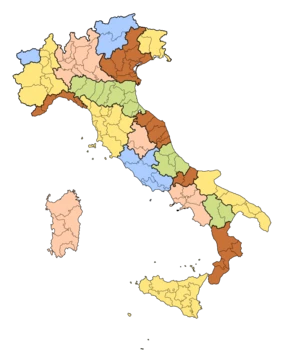
Tuscany
Central Italian region, birthplace of the Renaissance and Italian language.

Tuscany is a region of central Italy, known for its landscapes, history, artistic legacy, and influence on high culture. It is regarded as the birthplace of the Italian Renaissance and of the foundations of the Italian language. The capital and largest city is Florence.
- Known for
- Birthplace of the Italian Renaissance, foundations of the Italian language, wines (Chianti, Brunello di Montalcino), World Heritage Sites
Lore & Background
The pre-Etruscan history of Tuscany includes the Apennine culture (c. The Etruscans created the first major civilization in the region, living in Etruria from the tenth century BCE and reaching their peak during the seventh and sixth centuries BCE, before succumbing to the Romans by the first century BCE. The name Tuscany derives from the Etruscans, via Etruria and Tuscia. After absorbing Etruria, the Romans conquered or refounded existing Etruscan settlements, including Lucca and Pisa, while establishing Florence as a new colony. Siena is traditionally believed to have been founded by the Romans (as Saena Julia) under Augustus, though its Etruscan origins are debated. The Romans introduced roads, aqueducts, and sewers. During the medieval period, pilgrims on the Via Francigena brought wealth, and the conflict between Guelphs and Ghibellines split the Tuscan people, giving rise to communes such as Arezzo, Florence, Lucca, Pisa, and Siena. Tuscany, especially Florence, is regarded as the birthplace of the Renaissance. In the 15th century, Florence extended its dominion through annexation of Arezzo, purchase of Pisa, and acquisition of Livorno.
Reader's Guide
Tuscany's significance lies in its role as the birthplace of the Italian Renaissance and the foundation of the Italian language, largely due to the literary prestige of Dante Alighieri, Petrarch, Giovanni Boccaccio, Niccolò Machiavelli, and Francesco Guicciardini. The region has been home to many influential figures in art and science, and contains renowned museums such as the Uffizi and the Palazzo Pitti. Tuscany is also known for its wines, including Chianti, Vino Nobile di Montepulciano, Morellino di Scansano, Brunello di Montalcino, and Vernaccia di San Gimignano. Eight Tuscan localities have been designated World Heritage Sites, including the historic centres of Florence, Pisa, San Gimignano, Siena, and Pienza, as well as Val d'Orcia, the Medici Villas and Gardens, and Montecatini Terme. It is the second-most-popular Italian region for travelers, after Veneto, with main tourist spots including Florence, Pisa, San Gimignano, Siena, and Lucca. Castiglione della Pescaia is the most visited seaside destination, with seaside tourism accounting for approximately 40% of tourist arrivals. The region's strong linguistic and cultural identity leads it to be sometimes considered 'a nation within a nation'.
Did You Know?
- The Etruscans created the first major civilization in the region, and the name Tuscany derives from them.
- Seven Tuscan localities have been designated World Heritage Sites, including the historic centre of Florence and the Cathedral square of Pisa.
Cultural & Linguistic Legacy
Tuscany's influence on Italian culture extends far beyond its borders. The region is widely recognized as the cradle of the Italian Renaissance and as the wellspring from which the modern Italian language emerged. The literary prestige that the Tuscan dialect gained through the works of Dante Alighieri, Petrarch, Giovanni Boccaccio, Niccolò Machiavelli, and Francesco Guicciardini ultimately led to its adoption as the foundation for the language of culture across all of Italy. This linguistic dominance, combined with a deep artistic heritage, has given Tuscany a distinctive identity that many observers describe as a nation within a nation. The region produced countless figures who shaped the trajectory of art and science, and its museums—most notably the Uffizi and the Palazzo Pitti—stand as enduring testaments to that creative output. Florence, the capital and largest city, serves as the beating heart of this cultural tradition, anchoring a region whose population of roughly 3.66 million spread across about 23,000 square kilometres carries a legacy that continues to define Italian high culture.
Ancient Roots & Medieval Power
Long before the Renaissance, the Tuscan landscape was shaped by successive civilizations. The Etruscans, known to the Romans as the Tusci, built the first major regional civilization here, developing transport networks, agriculture, mining, and a vibrant artistic tradition between the Arno and Tiber rivers. Their peak came in the seventh and sixth centuries BCE before Roman absorption by the first century BCE. Rome then established cities including Lucca, Pisa, Siena, and Florence, introducing aqueducts, sewers, and road extensions. After the fall of the Western Roman Empire, the region passed through Gothic and Byzantine hands before the Lombards arrived in the 570s, making Lucca their capital. The medieval period saw the Via Francigena pilgrimage route bring wealth to communities clustered around churches and taverns. The Guelph-Ghibelline conflict over Papacy versus the Holy Roman Empire fractured Tuscan society and gave rise to powerful communes—Pisa with its port, Siena and Lucca with banking and silk, and Arezzo. Florence eventually emerged as the cultural capital, a position cemented by the Medici family, whose patronage under figures like Lorenzo de' Medici left an indelible mark on the city's art and architecture.
World Heritage & Tourism
Tuscany ranks as Italy's second-most-visited region, trailing only Veneto, and its appeal is anchored by an extraordinary concentration of UNESCO World Heritage Sites. Eight localities carry this designation: the historic centre of Florence (1982), the Cathedral square of Pisa (1987), San Gimignano's medieval core (1990), Siena's historical centre (1995), Pienza (1996), the Val d'Orcia landscape (2004), the Medici Villas and Gardens (2013), and Montecatini Terme as part of the Great Spa Towns of Europe (2021). Beyond these landmarks, the region maintains more than 120 protected nature reserves. The main draw for visitors includes Florence, Pisa, San Gimignano, Siena, and Lucca, while Castiglione della Pescaia leads as the most-visited seaside destination, with coastal tourism representing roughly 40 percent of all arrivals. The Maremma, Chianti, Versilia, and Val d'Orcia regions enjoy international renown. In 2018, Florence alone recorded over five million arrivals, placing it as the 51st most-visited city in the world.
Wine & Regional Identity
Tuscany's viticultural reputation is inseparable from its broader cultural identity. The region produces a constellation of celebrated wines, each tied to a specific terroir and tradition: Chianti, Vino Nobile di Montepulciano, Morellino di Scansano, Brunello di Montalcino, and the white Vernaccia di San Gimignano. These appellations are not merely commercial products but expressions of a local pride that permeates every aspect of Tuscan life. The region's strong linguistic and cultural self-identification—sometimes characterized as a nation within a nation—finds parallel in its wine culture, where local naming conventions and production methods reflect centuries of regional autonomy. This identity is layered atop a history that stretches from the Apennine culture's Bronze Age trade links with Minoan and Mycenaean civilizations, through the Proto-Villanovan and Villanovan periods, to the Etruscan chiefdoms that first organized the landscape into city-states. The continuity of place, language, and craft across millennia gives Tuscany a coherence that few other regions can claim, making its wines as much a narrative of identity as a product of soil and climate.
Frequently Asked Questions
Who is Tuscany?
Tuscany is a central Italian region whose identity is built around its rolling countryside, historic cities, and its role as the cradle of the Renaissance. Florence serves as both its capital and its most iconic city.
What are Tuscany's signature abilities?
Tuscany's greatest contributions are the birth of the Italian Renaissance and the establishment of the foundations for the modern Italian language. It also produces world-renowned wines like Chianti and Brunello di Montalcino, and hosts multiple UNESCO World Heritage Sites.
Where is Tuscany based?
Florence functions as Tuscany's capital and largest city, anchoring the region as its cultural and administrative heart.
Why is Tuscany considered so important in the overall story?
Tuscany is widely regarded as the region where the Italian Renaissance took root, shaping art, science, and philosophy for centuries to come. It also laid the groundwork for the standard Italian language as we know it today.
How does Tuscany's arc continue?
Rather than having a definitive ending, Tuscany's story is an ongoing one, with its landscapes, vineyards, and artistic heritage continuing to influence global culture and high art. Its World Heritage Sites and wine traditions keep its legacy alive for new generations.
More in Italian Regions 1-17
Spotted an error? Know more?
This is a living reference — every entry is fact-audited, and reader corrections feed straight into our audit queue. Suggest an edit · See this site's audit record