Apulia
Region of southern Italy with ancient Greek and Roman heritage.

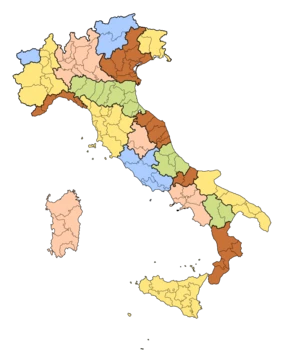
Apulia, also known by its Italian name Puglia, is one of the 20 regions of Italy, located in the southern peninsular section of the country. It borders the Adriatic Sea to the east, the Strait of Otranto and Ionian Sea to the southeast, and the Gulf of Taranto to the south, and is bordered by the regions of Molise, Campania, and Basilicata. The regional capital is Bari. Its coastline is longer than that of any other mainland Italian region, and it is home to two national parks, the Alta Murgia National Park and Gargano National Park.
- capital
- Bari
- climate
- Mediterranean
Lore & Background
Around the 1st millennium BC, the Iapygians settled the territory with tribes including the Daunians, Peucetians, and Messapians. During the 8th century BC, coastal areas were populated by ancient Greeks, and in the Hellenic era, Magna Graecia colonies were numerous, including the city of Taras (now Taranto).
Reader's Guide
Apulia's significance lies in its long and layered history, from prehistoric human settlement through Greek colonization, Roman conquest, and successive rule by Byzantines, Normans, Aragonese, Spanish, and the Kingdom of the Two Sicilies before annexation to the unified Kingdom of Italy after the Expedition of the Thousand. The region was a major exporter of grain and olive oil in Roman times, and later under Norman rule, the Duchy of Apulia and Calabria was established. In the 13th century, under Frederick II, Apulia achieved great material and civil progress, with construction of Castel del Monte. In the early modern period, it experienced economic prosperity and modernization under Napoleonic rule. In the 1970s and 1980s, its economy shifted from agriculture to services, with notable development in tourism. Its geography, including the Gargano promontory and Salento peninsula, and its Mediterranean climate contribute to its distinct character.
Did You Know?
- Apulia's coastline is longer than that of any other mainland Italian region.
Geography & Regional Identity
Apulia, known in Italian as Puglia, occupies the southern peninsular section of Italy as one of the country's twenty regions. Stretching across 19,540.90 square kilometers (7,544.78 square miles), the region is home to approximately 3,865,277 people as of 2026. Its geography is defined by water on three sides: the Adriatic Sea laps against its eastern shore, the Strait of Otranto and the Ionian Sea frame the southeast, and the Gulf of Taranto curves along the south. To the north, Molise draws the border; Campania lies to the west; and Basilicata anchors the southwest. Bari serves as the regional capital. The dual naming—Apulia in English and broader international contexts, Puglia in everyday Italian life—reflects the region's layered linguistic heritage. This coastal and peninsular positioning has made Apulia a natural crossroads, a fact that would prove decisive throughout its long history of conquest, trade, and cultural exchange.
Ancient Roots & the Roman Conquest
The story of Apulia stretches back an astonishing 250,000 years, anchored by the fossil remains of the Altamura Man, an archaic Neanderthal form discovered in the region. Prehistoric menhirs and dolmens dot the landscape as silent witnesses to even earlier human presence. By the first millennium BC, the Iapygian peoples—organized into the Daunian, Peucetian, and Messapian tribes, alongside the Calabrian and Sallentine communities of the Salento Peninsula—had established themselves across the territory. Greek colonists followed, settling the coastal zones from the eighth century BC onward, and by the Hellenic era, Magna Graecia colonies flourished, particularly in the south, with the city of Taras (modern Taranto) among the most prominent. Rome's grip on the region came hard-won. The disastrous Battle of the Caudine Forks in 321 BC and the catastrophic defeat at Cannae in 216 BC against Hannibal's Carthaginian forces underscored how fiercely contested this land was. Yet once consolidated, Apulia became a vital grain and olive-oil exporter to the East, and the Appian Way and later the Via Traiana linked its prosperous cities—Troia, Ordona, Gravina, Canosa, Ruvo, and Bitonto—into the Roman economic machine.
Medieval Rulers & the Norman Transformation
After the Western Roman Empire crumbled in 476, Apulia became a revolving door of empires. Ostrogothic rulers maintained the old Roman provincial structure, but Justinian I's Gothic War (535–554) restored Byzantine control. The Lombard invasions from 569 onward fragmented the region, and by the ninth century, Saracen raiders had even established the Emirate of Bari on the coast before being expelled in the 870s. The true turning point arrived with the Normans. In 1043, William of Hauteville founded the county of Apulia, which his younger brother Robert Guiscard expanded into the vast County of Apulia and Calabria in 1057, eventually becoming the Duchy of Apulia and Calabria. Taranto served as the capital of the Principality of Taranto across the Terra di Otranto. From 1130, the region fell under the Kingdom of Sicily, and it was during the Sicilian period—peaking under Frederick II—that Apulia achieved remarkable material and civil advancement. Frederick's building program produced structures of high artistic value, including the iconic Castel del Monte near Andria, while Foggia became one of his favored residences.
From Kingdom to Modern Italy
Following the separation of Sicily from the mainland in 1282, Apulia came under the Kingdom of Naples, a political shift that allowed the power of local landowners to take deep root in the territory. The region subsequently passed through periods of Aragonese and Spanish rule before becoming part of the Kingdom of the Two Sicilies. The mid-eighteenth century ushered in a period of strong economic prosperity, with trade and agriculture developing significantly. The Napoleonic era, spanning 1806 to 1815, delivered a critical modernization: feudalism was abolished and judicial reform was introduced. The decisive political turning point arrived with the Expedition of the Thousand, after which Apulia was annexed to the unified Kingdom of Italy. This unbroken succession of dominions—from Iapygian tribes and Greek colonies to Roman legions, Norman dukes, and Sicilian kings—has left the region with a layered cultural and architectural heritage. Today, embodied in its capital Bari and its nearly four million inhabitants, Apulia carries the imprint of every civilization that has shaped its landscape.
Frequently Asked Questions
Who is Apulia?
Apulia, also called Puglia, is one of Italy's 20 regions nestled in the southern peninsula, flanked by Molise, Campania, and Basilicata. It opens onto the Adriatic Sea to the east, the Ionian Sea to the southeast, and the Gulf of Taranto to the south.
What makes Apulia stand out among the other regions?
Apulia claims the longest coastline of any mainland Italian region, giving it a uniquely expansive maritime footprint. It also shelters two national parks, including the Alta Murgia National Park, adding a layer of protected natural heritage.
What is Apulia's capital and where does it sit?
Bari serves as the regional capital, anchoring Apulia's political and cultural life on the Adriatic coast. It functions as the primary gateway for visitors exploring the region's broader landscape.
Why is Apulia historically important?
Apulia carries deep layers of ancient Greek and Roman heritage, making it one of the most historically rich territories in southern Italy. That long cultural legacy still shapes its architecture, traditions, and regional identity today.
More in Italian Regions 1-17
Spotted an error? Know more?
This is a living reference — every entry is fact-audited, and reader corrections feed straight into our audit queue. Suggest an edit · See this site's audit record