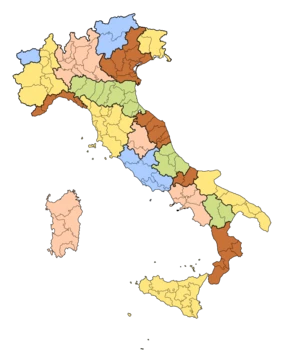
Basilicata
Southern Italian region with ancient Lucanian and Byzantine heritage.

Basilicata, also known by its ancient name Lucania, is an administrative region in Southern Italy. It borders Campania to the west, Apulia to the north and east, and Calabria to the south, with coastlines on the Tyrrhenian and Ionian Seas. The region is notable for its ancient Lucanian heritage, its role as the first capital of the Norman County of Apulia at Melfi, and its enduring linguistic enclaves.
- Capital
- Potenza
- Provinces
- Potenza and Matera
- Inhabitants known as
- Lucanians (lucani), also basilicatesi
- Ancient name
- Lucania
Lore & Background
Basilicata's territory was originally known as Lucania, named for the Lucani, an Oscan-speaking Italic population. In ancient times, it belonged to Magna Graecia, with Greek colonies such as Sybaris along its coasts. The Hohenstaufen emperor Frederick II reorganized the region, creating the Justiciarate of Basilicata and promulgating the Liber Augustalis at Melfi.
Reader's Guide
Basilicata's significance lies in its layered history as a crossroads of ancient Italic, Greek, Roman, Byzantine, Norman, and later Spanish and Bourbon rule. Its name likely derives from the Greek basilikos, referring to Byzantine emperors who governed the region as the Catepanate of Italy. Post-unification poverty led to brigandage, notably led by Carmine Crocco. After World War II, land reform improved conditions. The region's legacy includes its role in the Norman consolidation of southern Italy, its medieval legal code, and its preservation of distinct linguistic enclaves.
Did You Know?
- The name Basilicata probably derives from the Greek basilikos, referring to Byzantine emperors who ruled the region.
- The region has two coastlines: a 30-kilometer stretch on the Gulf of Policastro (Tyrrhenian Sea) and a longer coastline along the Gulf of Taranto (Ionian Sea).
The Arch of the Boot: Geography and Identity
Basilicata occupies the arch of Italy's iconic boot silhouette, with Calabria serving as the toe to the south and Apulia as the heel to the north and east, while Campania presses against its western flank. The region is distinctive in holding two separate coastlines: a modest 30-kilometre ribbon along the Gulf of Policastro on the Tyrrhenian Sea, tucked between Campania and Calabria, and a more extensive shore along the Gulf of Taranto on the Ionian Sea, wedged between Calabria and Apulia. Its capital is Potenza, and the territory is split into two provinces—Potenza and Matera. Roughly 525,000 people inhabit an area of about 10,073 square kilometres, making it a notably sparsely settled region. Residents are most often called Lucanians (lucani in Italian), a label that reaches back to the ancient inhabitants of the land, though the less common term basilicatesi also circulates. The twin names—Basilicata and its older form Lucania—encode centuries of shifting rule and identity into a single place.
Magna Graecia and the Lucanian World
The ancient landscape of present-day Basilicata was a stage for one of the Mediterranean's great cultural collisions. The indigenous Lucanians, an Oscan-speaking Italic people originally from central Italy, held the interior highlands and river valleys. From the late eighth century BC, Greek colonists arriving from the Aegean islands and Anatolia began establishing footholds along the Ionian coast. Siris was the first, founded by exiles from Colophon, followed by Metaponto, planted by Achaean settlers. These nuclei triggered a wider Greek expansion, and the territory became a pillar of Magna Graecia, studded with Greek póleis. Indigenous Oenotrian communities at Velia and Pyxous also leveraged their proximity to Greek settlements for maritime commerce. Roman contact with the Lucanians surfaced in the latter half of the fourth century BC. After Taranto fell in 272 BC, Roman authority swept across the region: the Appian Way was extended to Brindisi, and the colonies of Potentia—today's Potenza—and Grumentum were founded to anchor imperial administration in the territory.
A Palimpsest of Empires and a Name
The very name Basilicata is a sediment of successive rulers. The leading etymology links it to the Greek basilikos, pointing to the basileus—the Byzantine emperors—who governed the region for roughly two centuries as the Catepanate of Italy, first between 536/552 and 571/590, then again from 879 to 1059. A rival theory ties the name to the Basilica of Acerenza, which wielded judicial power during the Middle Ages. After the Western Roman Empire crumbled in 476, Germanic peoples held the land until Byzantine generals Belisarius and Narses wrested it from the Ostrogoths. It then fell under the Lombard Duchy of Benevento, endured Saracen raids that pushed coastal dwellers to hilltop refuges, and was reclaimed for Byzantium in the late ninth century under Nikephoros Phokas the Elder. The theme of Lucania was formally created in 968, capitalised at Tursi. Around the year 1000, the Norman Hauteville family conquered the region, a presence whose linguistic echo persists in Gallo-Italic enclaves. Aragonese and Spanish domination followed, and the territory ultimately joined the Kingdom of the Two Sicilies before entering the unified Kingdom of Italy in 1861.
Deep Time: Prehistory and the First Settlers
Basilicata's human narrative reaches into the late Paleolithic, when Homo erectus left the earliest known traces of habitation in the region. The geological record preserves Late Cenozoic fossils at Venosa and other sites, including elephants, rhinoceros, and a now-extinct saber-toothed cat of the genus Machairodus. Mesolithic rock art discovered near Filiano offers a rare window into symbolic expression long before writing. By the fifth millennium BC, communities had abandoned cave dwelling in favour of hut settlements strung along rivers feeding the interior—Tolve, Tricarico, Aliano, Melfi, and Metaponto—sustaining themselves through cereal cultivation and the herding of cattle and sheep. Chalcolithic evidence surfaces in the grottoes of Latronico and the funerary remains at the Cervaro grotto near Lagonegro. The Bronze Age produced the first known stable market centre of the Apennine culture on the sea: a cluster of huts perched on the promontory of Capo la Timpa near Maratea. Iron Age communities then organised into large plateau villages at the junctions of plains and rivers, including Tursi—then called Anglona—between the valleys of the Agri and Sinni, and Incoronata-San Teodoro on the Ionian shore.
Frequently Asked Questions
Who is Basilicata?
Basilicata is a Southern Italian region whose ancient name is Lucania, with Potenza serving as its capital city. Its residents are called Lucanians (lucani) or basilicatesi, and the territory is split into two provinces: Potenza and Matera.
What are Basilicata's powers/role?
Basilicata holds the distinction of being the site where Melfi served as the first capital of the Norman County of Apulia. The region also carries deep roots in Magna Graecia and preserves enduring linguistic enclaves that set it apart from its neighbors.
Why is Basilicata important?
Basilicata's position between Campania, Apulia, and Calabria made it a contested crossroads for every major power that shaped Southern Italy. Its ancient Lucanian identity and Byzantine-era heritage give it a cultural depth that few neighboring regions can match.
More in Italian Regions 1-17
Spotted an error? Know more?
This is a living reference — every entry is fact-audited, and reader corrections feed straight into our audit queue. Suggest an edit · See this site's audit record