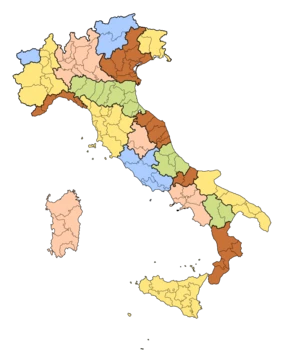
Molise
Second smallest Italian region, created in 1963 from Abruzzo.

Located in southern Italy, it was created in 1963 from the division with Abruzzo, with which it had formed the region of Abruzzi e Molise. Its regional capital and largest city is Campobasso.
- Capital
- Campobasso
- Provinces
- Campobasso and Isernia
- Established
- 1963
- Nationality
- Italian
Lore & Background
The name Molise first appeared during the High Middle Ages as the name of a Norman county, roughly between Torella del Sannio and Duronia. The county's name came from the de' Moulins family. Before the Romans, Molise was part of Samnium, inhabited by Samnite populations. The Samnite Wars with Rome led to Roman conquest, and under Augustus the territory was placed in Regio IV Samnium. During the Middle Ages, under the Lombards, the region was divided into gastaldates, and many towns were founded. The Normans ruled from the 9th to 11th centuries, and the area became known as comitatus molisii. After Frederick II's reforms, the Contado di Molise became part of a single administrative district with Terra di Lavoro.
Reader's Guide
Its history as a Norman county and later as part of the Kingdom of Naples reflects the shifting political boundaries of southern Italy. The region's geography is mostly mountainous, with 55% covered by mountains and a 35 km coastline on the Adriatic Sea. The region is home to two ethnic minorities: Molisan Croats and Arbëresh speakers. Its legacy includes medieval castles, cathedrals, and archaeological sites that attract visitors interested in history and culture.
Did You Know?
- Molise was created in 1963 from the division with Abruzzo.
- The region's name comes from the Norman de' Moulins family.
- Molise has 35 km of sandy coastline on the Adriatic Sea.
Frequently Asked Questions
What are Molise's powers/role?
Molise's defining trait is its small, self-contained scale—it governs a tight inland-and-coastal strip without the sprawling complexity of its neighbors. That compactness lets it maintain a distinct local identity and a manageable two-province administrative structure.
Where does Molise come from?
Molise was split off from the combined Abruzzi e Molise region in 1963, gaining full independence as its own administrative entity. Before that division it had been administratively bundled with Abruzzo for decades.
Why is Molise important?
Molise stands out as one of Italy's most recent regional creations, proving that a small, largely inland territory can sustain its own government and cultural voice. Its 1963 separation became a model for how a sub-region can earn full autonomy within the Italian state.
How does Molise's story end?
Molise's story is still being written—it remains an active, self-governing Italian region well into the 21st century, continuing to balance its modest population against the pressures of a rapidly changing national landscape.
More in Italian Regions 1-17
Spotted an error? Know more?
This is a living reference — every entry is fact-audited, and reader corrections feed straight into our audit queue. Suggest an edit · See this site's audit record